


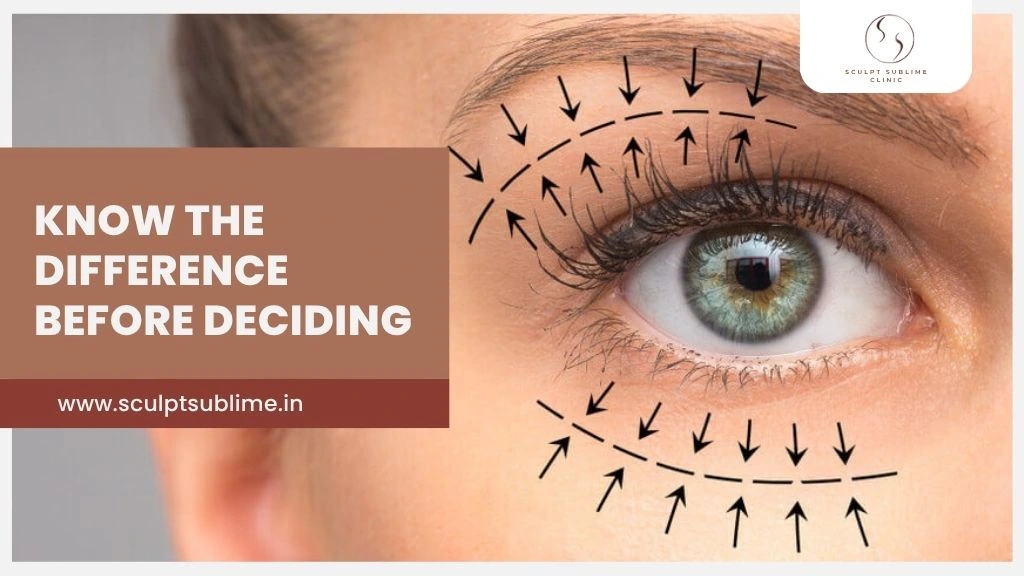
Upper vs Lower Blepharoplasty: Mapping Your 360-Degree Eye Rejuvenation
Choosing cosmetic eyelid surgery involves more than just fixing a single fold. It requires an understanding of how the upper and lower halves of the eye interact to create facial harmony. Many patients arrive at Sculpt Sublime seeking a single fix, only to realise that their aesthetic goals require a more holistic approach.
Think of your eye as a piece of art. The upper blepharoplasty structures the frame, the crisp, defined lid crease that gives the eye its shape. The lower blepharoplasty smooths the canvas, the delicate area where the lower lid meets the cheek. When these two work together, the result is a seamless, natural transition that looks effortless rather than as if it were operated on.
The Decision Matrix: Which Procedure Fits Your Anatomy?
Understanding your specific anatomical needs helps you partner with your surgeon in the planning phase. Each procedure targets distinct structural issues.
Symptom | Primary Concern | Recommended Procedure |
Heavy Hooding | Excess skin resting on the lash line. | Upper Blepharoplasty |
Hollow Tear Troughs | A sunken appearance or dark shadows. | Lower Blepharoplasty (Fat Repositioning) |
Protruding Bags | Herniated fat pads creating “puffiness.” | Lower Blepharoplasty (Fat Removal) |
Total Eye Ageing | Sagging on top and shadows on the bottom. | Combined 360-Degree Lift |
The Mechanics of Upper Blepharoplasty
During an upper blepharoplasty, the surgeon identifies the exact amount of skin and muscle needed to create a clean lid. At Sculpt Sublime, we prioritise a natural-first approach. We avoid over-resection, which can lead to a hollowed-out or startled appearance. Precision in upper blepharoplasty ensures that the eyes look wider and more alert without losing their characteristic warmth.
The goal differs based on gender and heritage. For women, we often aim for a graceful, high arch. For men, we preserve a lower, straighter crease to maintain masculine character. By hiding the incision within the natural fold of the lid, an upper blepharoplasty ensures the scar remains invisible when your eyes are open.
Ready for Your 360-Degree Refresh?
Blepharoplasty in Mumbai: Humidity Recovery Tips
Recovery in a tropical climate requires specific adjustments to manage post-surgical inflammation. High humidity can often slow down the initial resolution of fluid retention around the delicate eye tissues.
- The 30° Rule: Elevate your head at a 30° angle while sleeping for the first five nights. This gravity-assisted drainage is essential in coastal climates to prevent morning puffiness.
- Managing Coastal Swelling: High humidity often traps excess fluid near delicate eye tissues. We advise using specific clinical cooling protocols rather than unverified home remedies to reduce swelling actively. Targeted care prevents the heavy feeling frequently triggered by Mumbai’s moisture-rich air. You can find our complete, medically approved timeline for managing inflammation on our official eyelid surgery recovery page.
- Climate Control: Stay in a temperature-controlled environment during the first 48 hours to minimise vasodilation caused by heat.
The Art of Lower Blepharoplasty: Removal vs. Repositioning
The lower lid is technically more complex. Historically, surgeons simply removed fat to get rid of bags. However, fat removal alone often leaves patients looking sunken in a few years.
At Sculpt Sublime, we often utilise fat repositioning. Instead of discarding the fat, we move it into the tear trough (the hollow area under the eye). It creates a smooth transition from the lid to the cheek, creating a youthful, flat surface. For a deeper look at how we handle eyelid surgery for under-eye bags and sagging skin, exploring our specific technique guides provides much-needed clarity.
Why Combine Both Procedures?
Achieving periorbital harmony often requires addressing both the frame and the canvas simultaneously. If we perform only an upper blepharoplasty, the newly refreshed upper lid may inadvertently draw more attention to puffiness or hollowing on the lower lid.
Benefits of the 360-Degree Approach:
- Symmetry: We balance the tension and skin quality of the entire eye area at once.
- Efficiency: You undergo one round of anaesthesia and one recovery period.
- Proportional Ageing: The entire eye area ages uniformly after the procedure, maintaining a consistent look over time.
Surgical Precision and Muscle Support
Medical authority in cosmetic eyelid surgery comes from understanding what lies beneath the skin. We do not just stretch the surface. We support the Orbicularis Oculi muscle. By reinforcing muscle tone, we provide a structural foundation that keeps results crisp for a decade or more.
The Questions You Are Afraid to Ask
Many patients harbour secret fears they feel are too trivial or frightening to mention during a consultation. Transparency is the first step toward confidence.
- Will I be able to close my eyes fully?
This is the most common fear. At Sculpt Sublime, we use conservative measurement techniques to ensure your lids retain perfect functional movement. We prioritise your eye health over aggressive skin removal.
- Will I look like a different person?
You will look like a younger version of yourself. We do not alter your fundamental bone structure or eye shape. We simply remove the mask of sagging skin that hides your eyes.
- What if I sneeze during surgery?
Since we use local anaesthesia with light sedation, you remain comfortable and still. Our surgical team continuously monitors your reflexes to ensure your safety.
- Can I go blind?
While any surgery near the eye sounds high-stakes, blepharoplasty is a surface-level procedure. We do not operate on the eyeball itself, making the risk to vision extremely remote when performed by board-certified experts. To put your mind at ease regarding safety protocols, review our pre-op guide for under-eye bag removal.
Frequently Asked Questions
1. Can I do one procedure now and the other later?
You certainly can stage your surgeries. However, patients often find that a single, combined procedure is more cost-effective and convenient. Staging requires two separate healing phases, whereas a combined lift allows you to return to your routine in about a week.
2. Will combining both procedures increase my downtime?
Surprisingly, no. The swelling and bruising for a combined procedure occur during the same window as a single procedure. Most patients find that seven to ten days of social downtime is sufficient for both.
3. How do these procedures affect my natural eye shape?
Our “Natural-First” philosophy ensures your identity stays intact. We enhance your existing anatomy. We do not change the fundamental shape of your eyes, but rather remove the obstructions (skin and fat) that hide their beauty.
4. Are the scars different for each procedure?
Yes. Upper blepharoplasty scars hide in the natural lid crease. Lower blepharoplasty scars are often transconjunctival, meaning the incision stays inside the lid with no external scar at all.
5. Is there an age limit for a combined 360-degree lift?
There is no perfect age. We look at skin elasticity and structural health rather than the date on a birth certificate.