


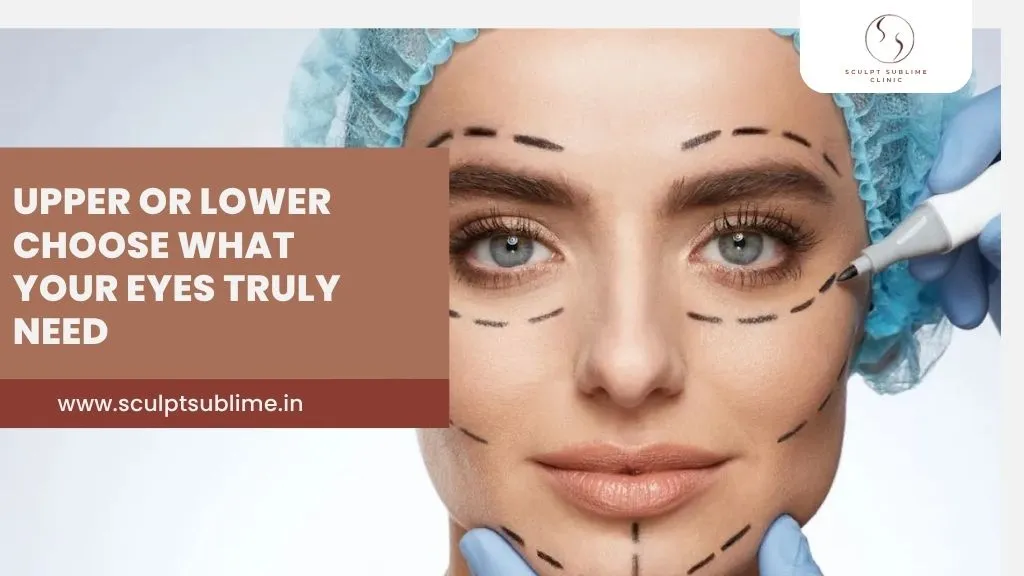
You look in the mirror. You pull the skin of your upper eyelids towards your temples. You think: “I just need this extra skin removed.”
This is the most common self-diagnosis we hear in our clinic. Facial ageing, however, is rarely that simple. Often, that “extra skin” is actually a descending brow. Those “dark circles” are frequently hollows caused by shifting facial fat. Choosing the wrong surgical procedure can leave you looking permanently angry or hollowed out.
Here is a clinical guide to understanding your exact periorbital anatomy. Stop guessing, and learn which procedure your eyes actually require.
Key Takeaways
- Upper blepharoplasty treats heavy, hooded eyelids, while lower blepharoplasty targets under-eye bags and hollows.
- Not all eyelid concerns are caused by excess skin brow position, fat loss, and muscle changes also play a major role.
- Modern eyelid surgery focuses on preserving and repositioning fat for natural-looking, youthful results.
- Choosing an experienced plastic surgeon is essential to avoid complications and achieve safe, balanced outcomes.
Understanding Periorbital Anatomy: A Clinical Perspective
The eyes age as a three-dimensional unit. Beneath the surface, the process involves more than just skin laxity. It is a combination of the Orbicularis Oculi muscle weakening, the herniation or bulging of orbital fat, and the gradual resorption of the underlying bone structure.
Different combinations of these factors produce the specific concerns we see in patients aged 35 to 65:
- Heavy Hooded Lids: Usually a result of skin laxity coupled with a descending brow.
- True Under-Eye Bags: Caused by fat prolapse, where the fat pads around the eye bulge forward.
- Hollows: Created by the loss or descent of facial fat into the mid-face.
At Sculpt Sublime, our first step is to map all three layers (skin, muscle, and fat) before recommending whether you need an upper, a lower, or a combined blepharoplasty.
Upper Blepharoplasty: Fixing Heavy, Hooded Lids
Upper eyelid surgery restores a crisp, defined eyelid crease. It removes excess skin and muscle, reducing the physical weight of your eyelids.
The Brow Trap
If your eyebrows sit low on your brow bone, an upper blepharoplasty alone will make your eyes look crowded. Removing eyelid skin in this scenario pulls the eyebrow even lower. You might actually need a brow lift instead.
Expert Insight: Clinical reviews on blepharoplasty complications highlight that removing too much skin or muscle increases the risk of lagophthalmos (incomplete lid closure) and exposure-related dry eye. This is why we err on the side of conservative tissue removal and modern techniques that favour preserving the orbicularis muscle wherever safe to do so.
Pros and Cons: Upper Blepharoplasty
Pros | Cons |
Clears obstructed peripheral vision | Risk of temporary dry eyes |
Creates a defined, youthful crease | Does not lift sagging eyebrows |
Shortest surgical downtime | Risk of lagophthalmos if over-resected |
Lower Blepharoplasty: Eliminating Under-Eye Bags
Lower eyelid surgery targets the bags and hollows beneath your eyes to restore a rested appearance.
Fat Repositioning vs Simple Removal
Traditional surgery simply removes the under-eye fat. Removing too much fat leaves you with a skeletal, aged appearance. Modern techniques require repositioning the fat or moving your prolapsed fat bags down into your hollow tear troughs to act as natural fillers.
The Scarless Approach
For patients with good skin elasticity, we perform lower blepharoplasty from inside the eyelid. This is called the transconjunctival approach, a method recognised by surgical literature as ideal for addressing fat bulging without external incisions.
Pros and Cons: Lower Blepharoplasty
Pros | Cons |
Eliminates a permanent “tired” look | Longer bruising period (7–10 days) |
Can be performed with no visible scars | Risk of ectropion (lower lid pull-down) if done poorly |
Smooths the mid-face transition | Does not fix skin surface pigmentation |
When Is the Right Time to Consider Eyelid Surgery?
While there is no “perfect” age, the right time is determined by specific triggers:
- Functional Triggers: Upper lids resting on lashes or narrowing your field of vision, making it difficult to read or work on screens.
- Aesthetic Triggers: Under-eye bags that persist despite adequate sleep, or looking “tired” or “angry” in photos when you feel perfectly well.
- Life-Planning: When you can set aside 10–14 days away from client-facing work and can comfortably delay wearing contact lenses for two weeks.
Comparison: Upper vs Lower Blepharoplasty at a Glance
Feature | Upper Blepharoplasty | Lower Blepharoplasty |
Primary Goal | Remove heavy skin | Eliminate bags / fill hollows |
Incision Site | Hidden in the natural crease | Inside the lid (scarless) |
Surgery Time | 45–60 minutes | 60–90 minutes |
Primary Risk | Incomplete lid closure | Lower lid malposition |
How Long to Recover From Eyelid Surgery?
When planning your procedure, understanding how long it will take to recover from eyelid surgery is vital to your professional schedule. Social recovery typically takes 10 to 14 days.
- Days 1–3: Peak inflammatory phase. Keep your head elevated and use cold compresses.
- Day 7: Suture removal. Bruising shifts to a yellow colour.
- Days 10–14: The social milestone. You can return to desk work and social events with camouflage concealer.
- Months 3–6: Final tissue settling. Micro-swelling resolves, and scars fade to subtle silver lines.
Eyelid Surgery Cost in India: Investing in Safety
When researching eyelid surgery cost in India, you’ll see a wide range of quotes. At Sculpt Sublime, our pricing reflects an uncompromising, hospital-grade safety standard:
- Upper Eyelid Blepharoplasty: ₹60,000 – ₹1,00,000
- Lower Eyelid Blepharoplasty: ₹80,000 – ₹1,20,000
Lower-cost quotes elsewhere usually signal a clinical compromise, such as the absence of a dedicated MD Anaesthetist or the use of lower-grade surgical materials. Your surgery at Sculpt Sublime is performed by an AIIMS-trained plastic surgeon in Mumbai, in a fully monitored operating theatre.
SAY GOODBYE TO HEAVY LIDS AND TIRED EYES
Next Steps: Your Clinical Evaluation in Mumbai
Eyelid surgery permanently alters your face. Do not rely on self-diagnosis. Allow an AIIMS-trained expert to accurately map your periorbital anatomy and determine the safest path forward.
Frequently Asked Questions
1. Can I do upper and lower blepharoplasty at the same time?
Yes. Combining them is highly recommended. It ensures facial harmony and reduces total facility and anaesthesia fees.
2. Will the surgery change my eye shape?
No. A correctly performed procedure restores your youthful, natural contour. It will not distort or change your natural eye shape.
3. Does eyelid surgery fix dark circles?
Only if they are shadows caused by fat bags, pigmentation-based circles require different treatments.
4. When can I wear contact lenses again?
You must wait 10 to 14 days to avoid tension on fresh incisions.
5. Is the procedure painful?
Most patients report mild ache, rating it 2 out of 10.
6. Do the results last forever?
Results are long‑lasting. Most patients enjoy a rejuvenated appearance for around 10 to 15 years before any subtle ageing changes may prompt a touch‑up.
7. Can I drive home after the surgery?
No. Protective eye ointments will blur your vision immediately following the procedure.
8. What is the biggest risk?
Dry eye and lid malposition. We mitigate these through strict pre-operative testing and conservative tissue handling.